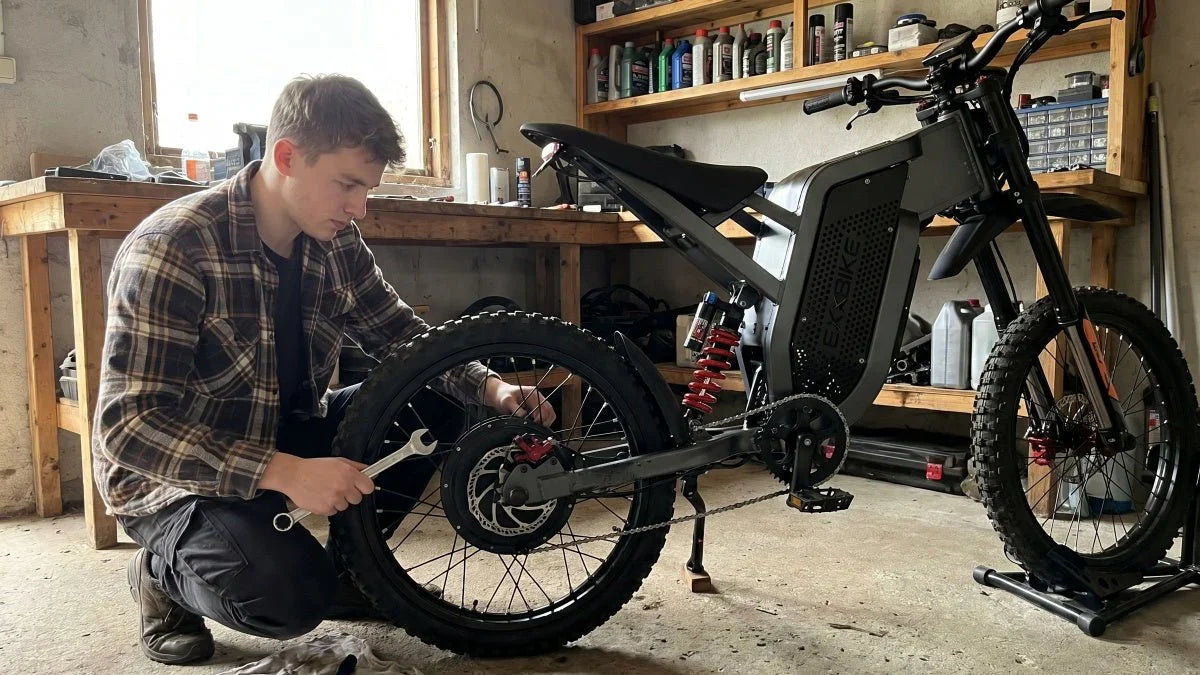
Buying a high-power e-bike is a blast, but let’s talk about the elephant in the room: maintenance. When your machine runs on heavy-duty 60V to 72V electrical systems putting out anywhere from 6000W to 16800W of peak power, you can’t just fix it with a basic bicycle wrench.
One of the most common questions out there is, “Can electric bike batteries be repaired?” What people are really asking is: If my bike breaks down, am I stuck with a multi-thousand-dollar paperweight?
Here is a down-to-earth breakdown of what you can actually fix on your bike, what you shouldn't touch, and how the right factory support saves you time and money.
1. The Real Deal on Battery Repairs
Think of your lithium-ion battery pack as a giant puzzle made of hundreds of small cells (similar to rechargeable AA batteries) welded together. When your battery acts up, it usually comes down to three things:

-
Cell Imbalance (The Chain Reaction): If a few cells go weak, the Battery Management System (BMS) cuts the power to stop a fire. Can a shop weld new cells in? Technically, yes. Is it a good idea? No. Mixing brand-new cells with old, worn-out cells creates mismatched resistance. Under heavy throttle, those old cells will overheat fast.
-
BMS Failure (An Easy Fix): Sometimes the battery cells are perfectly fine, but the circuit brain board (the BMS) fries. Swapping out a bad BMS is a straightforward, safe repair that doesn't ruin the battery.
-
Cracked Cases (Game Over): If you crash hard on an electric dirt bike and crack the battery casing, water and dirt will get inside. Moisture causes short circuits and fire hazards. Organizations like Call2Recycle state that water-damaged or physically smashed packs are toast—they need to be recycled, not patched up.
2. Troubleshooting Motors and Controllers
When a bike suddenly dies on the trail, everyone blames the battery. But most of the time, the trouble is actually hiding in the motor or the controller.
The FOC Controller
The Field-Oriented Control (FOC) controller is the middleman between your throttle and your battery. It pushes massive electrical currents to your motor. If your bike stutters or the throttle feels dead, a gatekeeper transistor called a MOSFET inside the controller probably blew out.
Controllers are vacuum-sealed at the factory to keep an IP67 waterproof rating. If you open the metal box to solder a cheap part at home, you destroy the waterproof seal. The next puddle you hit will ruin the whole thing. It’s always smarter to swap the whole controller module.
Center Motors vs. Wheel Motors
Where your motor sits changes how you maintain it. Hub motors sit right inside the rear wheel, meaning they take a beating from rocks and hard landings. If you choose a high-end mid-drive electric bike, the motor is safely bolted into the center of the frame.
While mid-drive motors handle trails way better, they put serious pressure on your chain and internal reduction gears. If you push the bike too hard for too long and burn out the copper wire insulation inside the motor (the stator), rewinding it by hand costs almost as much as a new motor. A factory-sealed replacement is the best way to get your torque back.
3. Why Local Bike Shops Won't Touch Your Ride
A lot of riders think, "If it breaks, I'll just take it to the bicycle shop down the street." Don't be surprised if they turn you away.
Standard bike mechanics are trained to handle chains, gears, and small 250W commuter bikes. They don't have the safety gear or training to handle high-voltage powertrains. Furthermore, safety frameworks like UL 2849 standards and TÜV Rheinland safety standards require the battery, motor, and charger to be tested as one complete system. If a local shop modifies your wiring with uncertified parts, it voids these safety ratings, and insurance companies can use that to deny claims if something goes wrong.
4. How EKXBIKE Makes Fixing Your Bike Stress-Free
You shouldn’t have to waste weeks hunting for sketchy third-party mechanics or waiting months for random parts. At EKXBIKE, we built our bikes to be incredibly easy to work on using two simple concepts: Modular Parts and Local Stock.

Simple Plug-and-Play Parts
We build our bikes like modern gaming PCs. Every major component—from the high-capacity battery to the FOC controller—connects using heavy-duty, quick-disconnect waterproof plugs.
If something stops working, you don't have to cut copper wires or weld circuit boards. You simply unplug the old part, bolt on the new one from our official parts and accessories collection, and plug it back in. It’s that simple.
Real Warranty Support When You Need It
We back our builds with a straightforward, domestic official warranty protection policy. Whether you are riding our top-tier EKX X21 Max Electric Dirt Bike or one of our mid-drive builds, our local fulfillment warehouses keep complete factory assemblies on the shelf.
If a part fails while you're covered, we ship a fresh, factory-sealed unit right to your house. You get a replacement part that fits perfectly, keeps your safety certifications intact, and gets you back out riding with minimal downtime.
5. Quick Maintenance FAQ
My bike cuts out when I hit the throttle hard, but turns back on when I flip the key. What's wrong?
Your battery cells are likely "sagging" under heavy loads, which drops the voltage and makes the BMS shut things down to protect the pack. This means your battery is getting worn out or imbalanced. If it were a bad controller, the bike usually won't turn back on at all or the motor will make a harsh grinding noise.
Can I get mechanical parts like brakes and rims easily?
Absolutely. High-torque Electric Motorcycles wear out brake pads, hydraulic rotors, and wheel rims much faster than regular bikes. We keep our warehouse stocked with genuine OEM replacements inside our parts and accessories collection so you can swap out worn hardware instantly without worrying about fitment issues.
Conclusion: Ride with Absolute Confidence
At the end of the day, owning a high-power vehicle shouldn't feel like a ticking financial time bomb. Patchwork garage fixes and risky uncertified electronics will only lead to short circuits and voided safety standards. By choosing a machine built around a certified, factory-sealed ecosystem, you completely remove the guesswork from ownership.
Through our committed after-sales service framework, we ensure you never have to deal with sketchy third-party troubleshooting or long parts delays. With our plug-and-play modular layout and fully stocked domestic fulfillment warehouses, keeping your powertrain running at peak parameters is as fast as it is safe. Your machine is built to handle the toughest trails—and our factory guarantee is built to ensure you can always ride it hard without limits.